

As part of its ongoing commitment to equity and inclusion, the district set out to understand whether its high school course placement structure, especially in 9th and 10th grade English and Social Studies, was creating unintended disparities among student groups. Leaders suspected that long-standing course “tracks” might be affecting which students had access to rigorous coursework, but pulling the data together manually would have taken weeks and required significant cross-department coordination.
The district wanted a clearer, data-driven answer to an essential question: “Are lower-level course tracks undeserving certain students, and would reducing or restructuring these tracks lead to more equitable opportunities?”
To explore this, the district turned to Nexus. Administrators entered a guiding question directly into the platform: “What are the differences between course levels in terms of demographics, grades, attendance, and discipline—and do those differences suggest inequitable access or outcomes?”
Nexus immediately connected data across SIS, assessment, and behavior systems, standardized definitions, and surfaced a full set of comparative insights. What once would have taken weeks of spreadsheet work was completed in minutes. The platform provided a clear, auditable, and structured comparison across all course levels, making it easy to visualize patterns and identify areas of concern.
The following charts illustrate how student experience differs across the three 9th grade literature tracks. By examining demographics, performance, attendance, and discipline side-by-side, district leaders can see how tracking shapes opportunity and outcomes, and where inequities may be emerging.
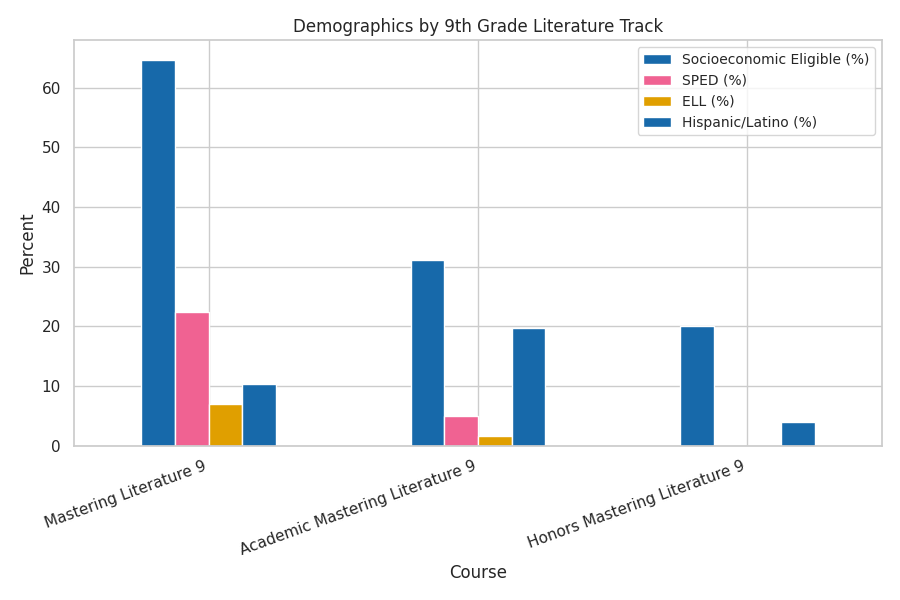
The demographics chart shows clear stratification across tracks. Mastering Literature 9 enrolls the highest proportions of economically disadvantaged, SPED, ELL, and Hispanic/Latino students, while Academic Mastering Literature 9 sits in the middle. Honors Mastering Literature 9 includes far fewer students from these groups, with no SPED or ELL students represented. This pattern highlights how tracking concentrates risk factors in the lowest level and creates a far more homogeneous honors group.
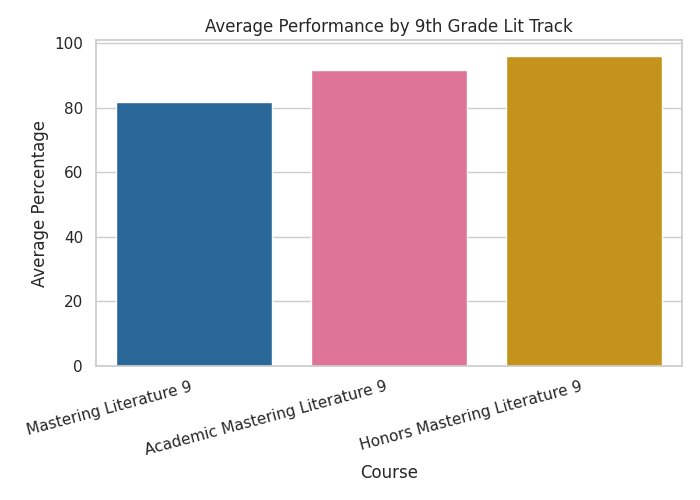
Average achievement rises sharply across the three tracks. Students in Mastering Literature 9 average 81.8%, compared to 91.8% in Academic and 96.1% in Honors. The lower track also shows wider variation and lower medians, while the upper tracks show both stronger and more consistent performance. These patterns suggest that track placement is closely tied to academic opportunity and outcomes.
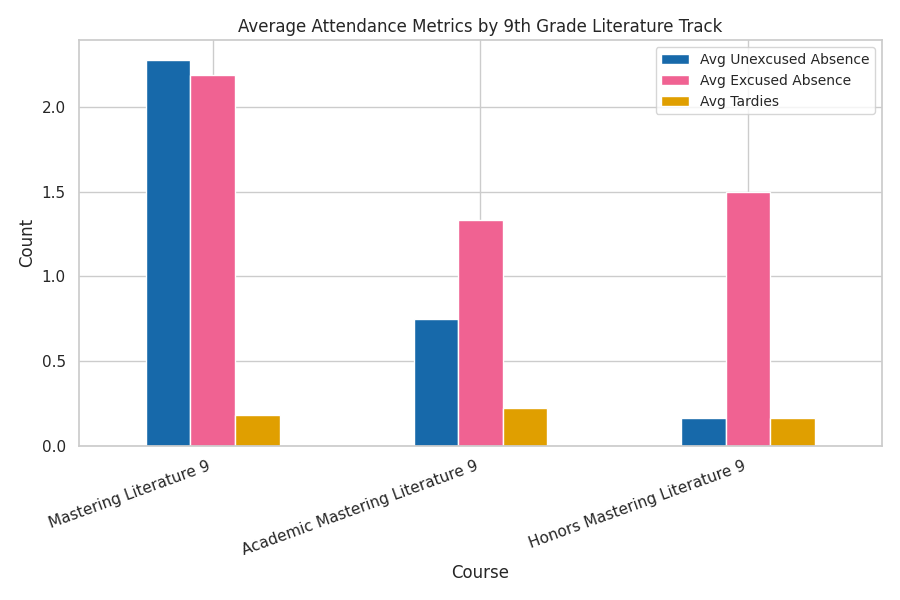
Attendance gaps follow a similar trend. Students in Mastering Literature 9 have significantly higher unexcused absences (2.28) than those in Academic (0.75) or Honors (0.16), with excused absences showing the same pattern. Tardies remain low across all groups. These differences point to meaningful disparities in engagement or school experience between tracks.
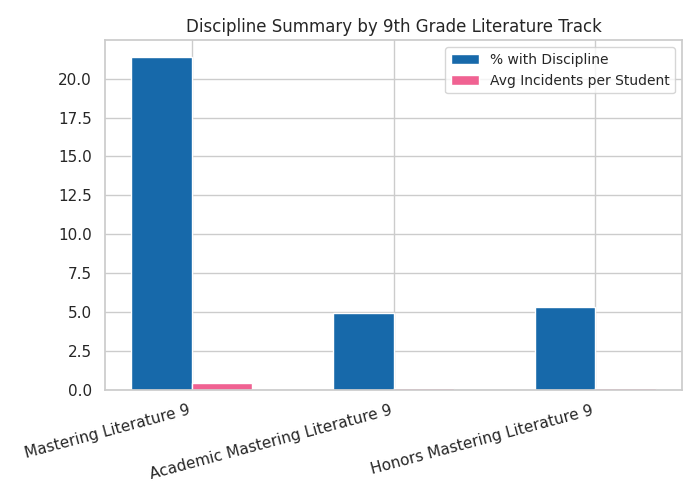
Discipline data show the starkest divide. Over 21% of students in Mastering Literature 9 have at least one incident, compared with under 5% in the upper tracks, and the average number of incidents per student is much higher in the lowest track. Common issues, such as classroom disruption and cutting class, appear almost exclusively in this group. The pattern aligns with known inequities in discipline and suggests that tracking may be reinforcing, rather than reducing, existing disparities.
Nexus uncovered a consistent and concerning pattern: student experience varied dramatically across course tracks.
Even without publishing the underlying numbers, the patterns were unmistakable, course level corresponded strongly with student background, academic performance, and behavioral outcomes.
These findings suggest that the district’s existing tracking structure may be unintentionally reinforcing inequity rather than reducing it. Lower-track courses appeared to concentrate nearly all major student risk factors, creating environments where struggling learners were clustered together with fewer opportunities for access to advanced coursework.
Nexus synthesized the analysis into a clear recommendation: “If the district’s goal is to improve equity and inclusion, the data strongly indicates a need to rethink or reduce lower-level tracks. Broadening access to higher-level coursework could help disrupt the stratification currently present in English and Social Studies placement.”
Nexus also encouraged a holistic approach, recommending that the district pair the quantitative findings with qualitative information, such as classroom observations, student/teacher feedback, and reviews of instructional supports, to ensure any structural changes aligned with the district’s broader instructional vision.
This case showcases how Nexus enables districts to ask complex, equity-centered questions and receive clear, timely answers. By bringing together data on demographics, performance, attendance, and discipline, Nexus helped the district uncover structural inequities that otherwise would have remained hidden in siloed systems.
The resulting insights are now guiding conversations about course access, instructional support, and long-term student opportunity. Through this process, the district is taking concrete steps to ensure that every student, regardless of background, has access to high-quality, rigorous learning pathways.

